
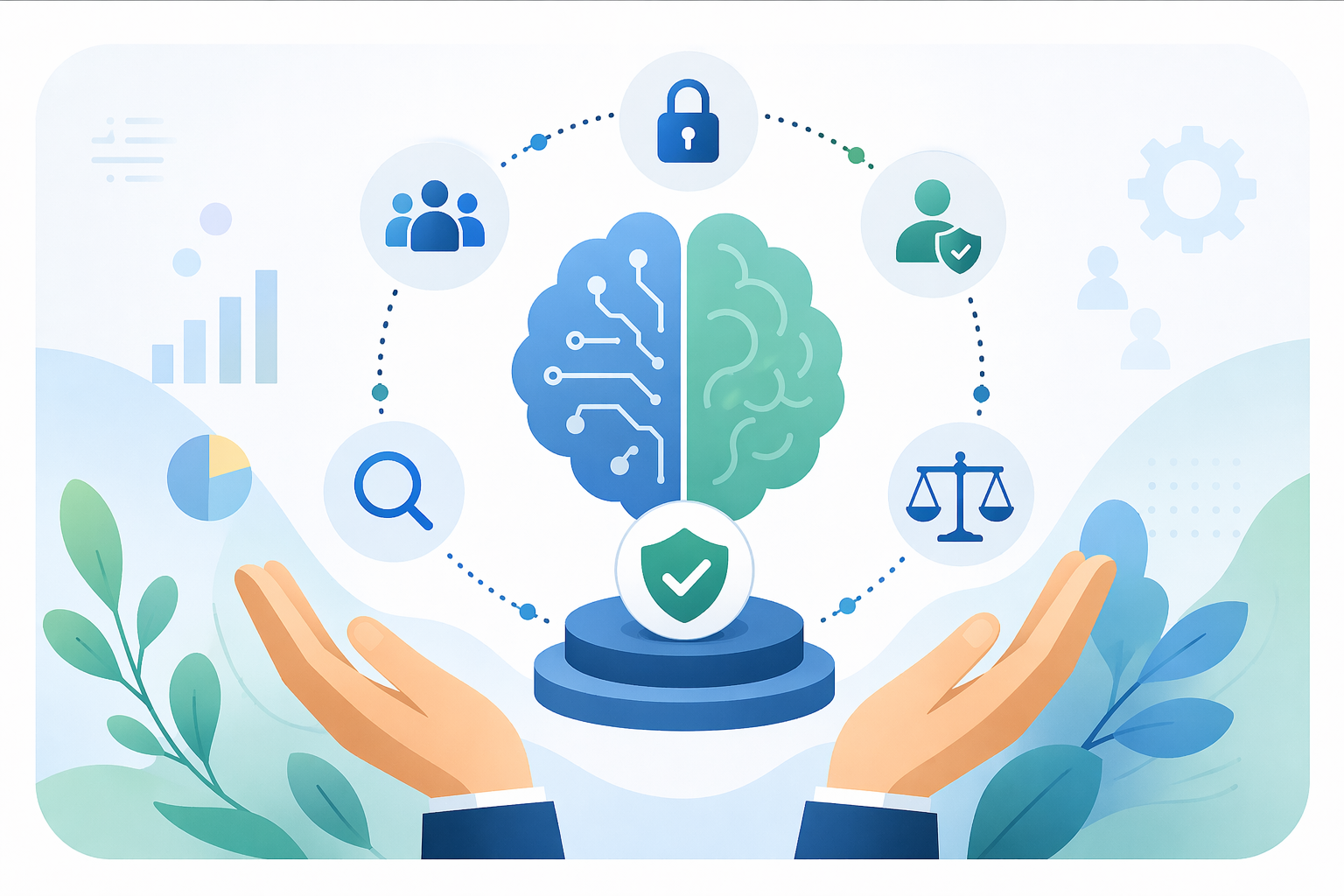
Artificial Intelligence has moved well past the initial hype. It's now part of everyday work — from customer support and marketing to inventory and product design. A recent Deloitte report found that about 60% of workers have access to sanctioned AI tools at work, which shows how quickly these technologies have spread across organizations.
That rapid spread is exactly why businesses must treat these tools as a governance and risk issue, not just a productivity win. When tools touch people, money or reputation, the stakes change: mistakes become visible fast, and the fallout can be costly for organizations.
Responsible use means knowing what you've deployed, who it affects, and how you'll manage the risks.
In this blog post, let's take a look at why responsible AI is important and what steps you can take.
Why responsible use of AI is vital
AI can speed up routine tasks, surface insights from large datasets, and reduce human error. Those are real benefits.
But they come with real risks.
AI models trained on biased or incomplete data can produce unfair outcomes. Systems that handle personal information can expose customers to privacy harms if data is mishandled. And unclear decision processes can damage trust and a company's reputation when things go wrong.
We've seen examples where recruitment tools of Amazon disadvantaged women, and in another case, where weak controls in financial systems led to discriminatory outcomes.
On top of that, regulation is tightening. The EU's AI Act began rolling out in 2025 and treats some systems as high risk, while laws like the GDPR require transparency, consent, and strong data protection. Non‑compliance can mean heavy fines and lasting reputational damage.
Bottom line: Treat AI as both an opportunity and an obligation — map your systems, manage risks, and keep oversight proportional to impact.
Recommended steps to use AI responsibly
1. Classify AI solutions
Start by listing every tool in use, who uses it, and what data it can access. Keep a note whether a tool affects customers, employees, or key business decisions. Keep the inventory simple and actionable such as name, owner, purpose, data sources, and impact level. This gives you a clear map of where to focus oversight.
2. Non‑negotiable risk assessments
For each system, run a short, practical risk check.
Look for bias in training data, privacy exposure, security gaps, and reputational damages. Record the risks and the concrete steps you'll take to reduce them — controls, testing cadence, and who signs off. Treat the assessment as a living document, not a one‑time exercise.
3. Assign governance roles
Give each system a named owner, a compliance lead, and a data POC. Make responsibilities explicit: who approves changes, who reviews data lineage, who handles incidents. Clear ownership stops issues from falling through the cracks and speeds up decision making when problems appear.
4. Timely and regular audits
Monitor systems continuously and audit them on a schedule. Set a few meaningful KPIs, run bias and performance tests, and log results. Have an incident plan that charts out who does what and how you communicate externally. Audits prove you're in control and help you catch drift before it becomes a crisis.
5. Train employees
Teach people how to use the tools safely. Run short, role‑specific sessions on privacy, ethics, and limits of the systems they use. Use real examples from your own environment so training feels relevant. When staff know the risks and the red flags, they become the first line of defence.
These steps are practical and achievable. Do them consistently, and responsible use becomes part of how you work — not an afterthought.
I hope this blog is helpful. If you want to implement AI in your organization and need consultation on best practices, connect with our experts here.