
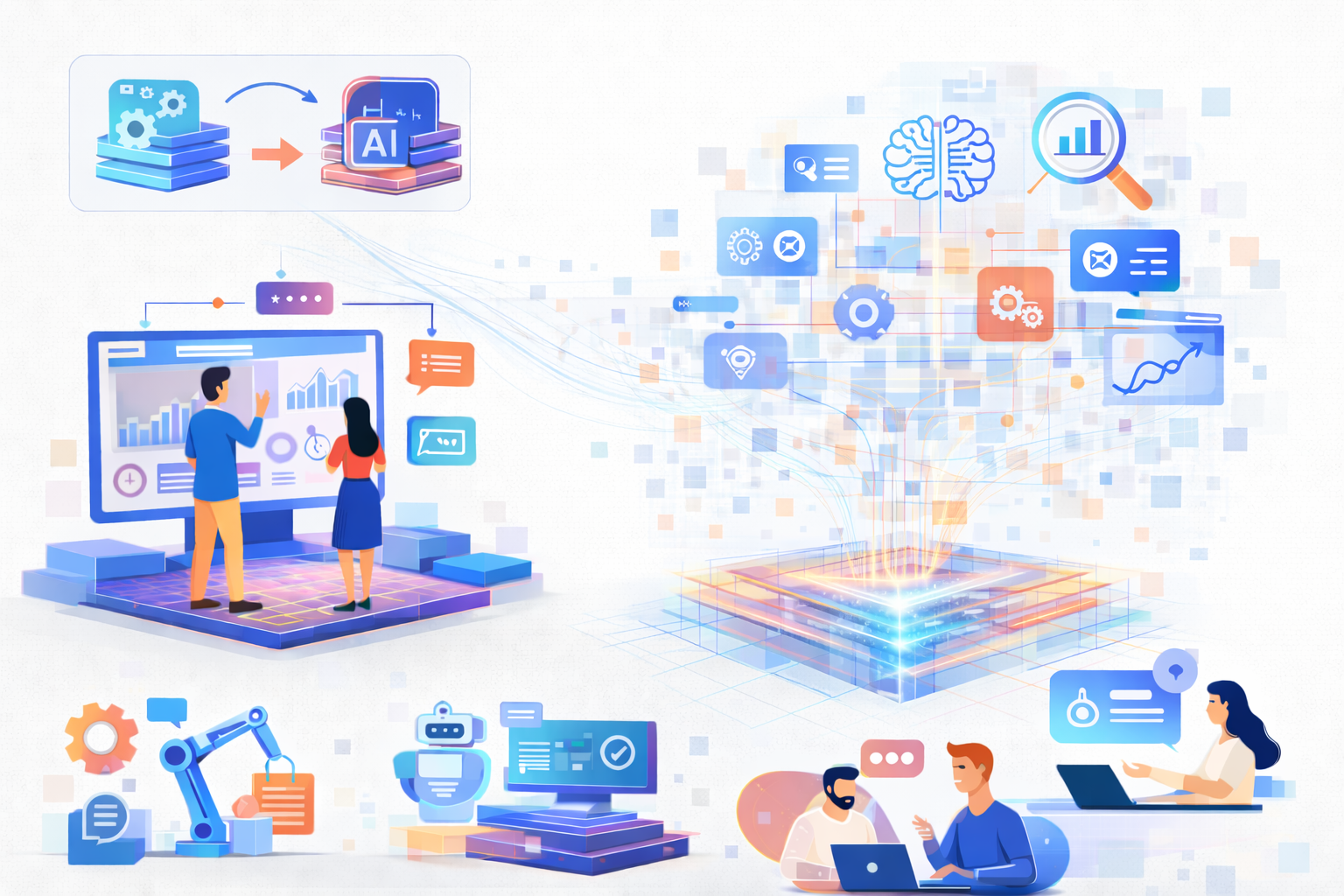
Businesses planning to make the most of AI—this is the best place to start.
Most organizations already have a solution or legacy system that performs its core functions well. However, as customer expectations and sales grow, businesses realize that adding intelligent solutions such as AI can enhance the value of these systems.
Instead of replacing the entire platform, a more practical approach is to integrate AI into the existing solution and make it smarter and more efficient.
This approach is commonly known as AI layering.
It allows organizations to introduce advanced capabilities on top of current platforms and improve efficiency with minimal disruption and maximum impact. Teams continue working in familiar environments while benefiting from faster decision-making, improved productivity, and more responsive workflows.
Let's talk about this in the blog here.
Why Replacing Existing Systems Is Not the Right Choice?
Replacing or rebuilding a platform requires extensive research, long implementation cycles, infrastructure changes, and high-cost investments. During rollout, operations may slow down and teams need retraining, which delays the realization of business value that a new tool brings in.
In many cases, the existing system is not the problem, but the absence of intelligence and automation is.
With layering AI capabilities over the current technology or solutions, organizations can value their earlier investments while gradually modernizing operations.
Key Takeaway
AI layering lets you preserve existing investments, avoid big-bang replacements, and add intelligence and automation without disrupting daily operations.
How AI Layering Adds Value to Existing Solutions
1. Smarter Decision-Making
As far as dashboards and reports are concerned, there is no need to integrate new BI solutions or train resources to continuously update reporting formats.
AI tools can seamlessly connect to existing data sources, dashboards, and reporting platforms to provide predictive insights and intelligent recommendations. This empowers leaders to make faster, data-driven decisions without redesigning reporting systems.
- Connect to existing data sources and dashboards
- Predictive insights and intelligent recommendations
- Faster, data-driven decisions without redesigning systems
2. Workflow Automation with AI
Certain business processes such as document processing, online chat assistance, customer ticket management, and service responses can be automated using AI while the underlying workflow platforms remain as is.
This helps reduce human error, minimize delays, and improve operational efficiency.
- Document processing and chat assistance
- Customer ticket management and service responses
- Fewer errors, fewer delays, higher efficiency
3. Improved Customer Experience
We have already discussed how integrating AI into tools such as CRM systems can significantly boost revenue potential.
Similarly, recommendation engines, conversational assistants, and personalization tools can be layered over existing websites, applications, or customer portals to increase engagement without rebuilding the product from scratch.
- Recommendation engines and conversational assistants
- Personalization on existing websites and portals
- Higher engagement without full product rebuilds
4. Productivity Improvement for Teams
Tools such as AI copilots and intelligent assistants can be added to platforms employees already use, helping them complete tasks, retrieve information quickly, and focus on work that brings higher value.
For example, these tools can analyze client notes, emails, and write JIRA user stories, helping teams reduce manual effort. Teams can also use them to summarize meeting notes and extract key action points quickly.
- AI copilots and intelligent assistants on existing tools
- Analyze notes, emails, and generate JIRA user stories
- Summarize meetings and extract action points
Conclusion
Integrating AI into existing systems is not about replacing what already works. It is about enhancing current platforms with intelligence, automation, and predictive capabilities, without hindering daily operations.
Hope these insights were helpful. If your organization is exploring ways to integrate AI into your existing solutions, connect with us for expert guidance and consultation on AI.