
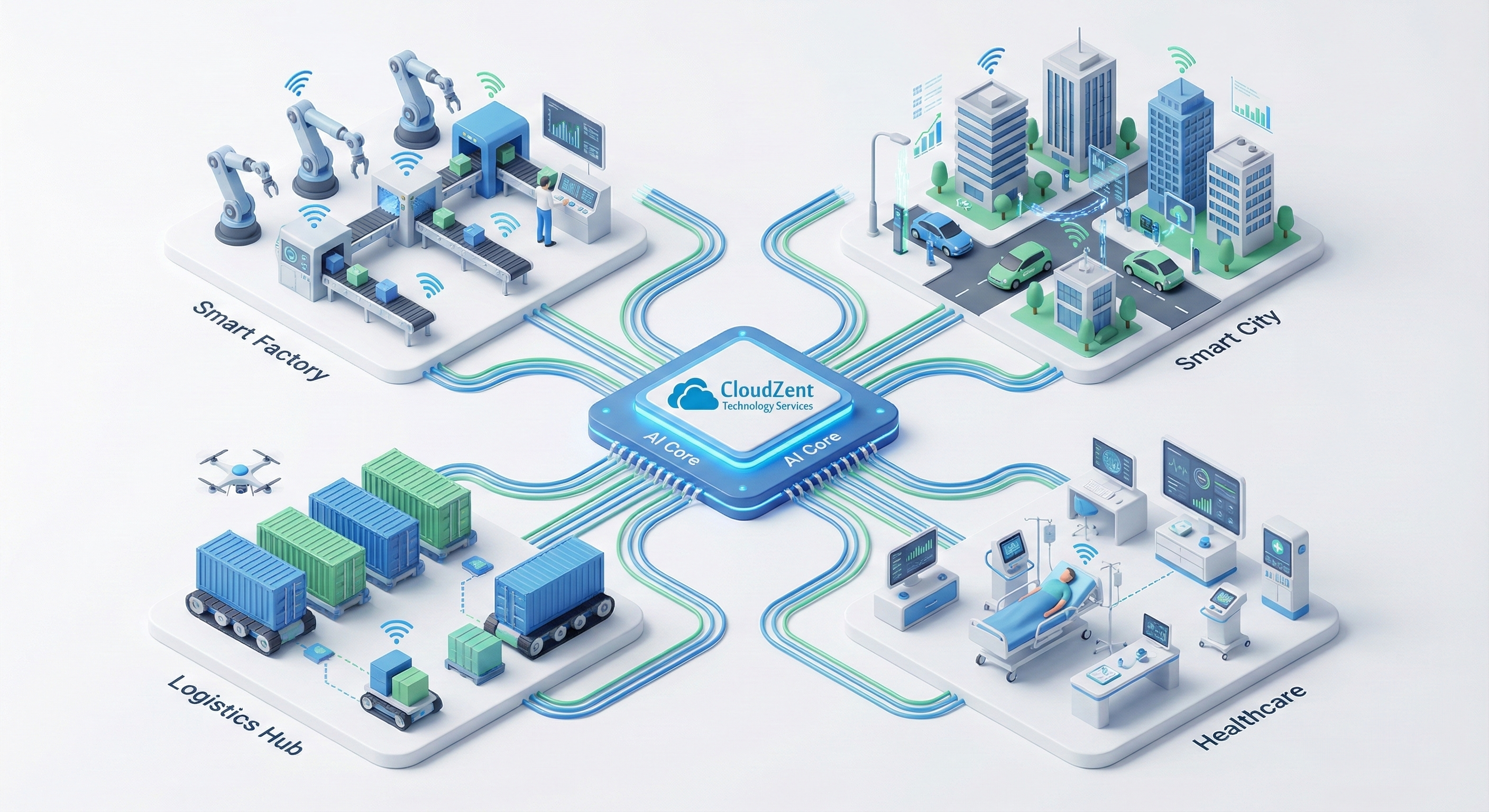
The Internet of Things (IoT) is the next focus point in the digitization in 2026.
The new year will fast-track IoT from early adoption to an essential part of infrastructure. While many industries have successfully implemented IoT in their businesses, the remaining ones are actively exploring to learn the key benefits such as cost-saving, improved efficiency, and data-driven decision-making.
In this new phase, IoT is no longer a new technology or an optional upgrade but the core of smarter industries, sustainable cities, improved healthcare, secure supply chains, and more.
Let's understand the basics of IoT in simple words and then deep dive to understand why the converging forces of technology and economics are making 2026 the year IoT truly becomes the next big thing in the digital world.
What is IoT?
The Internet of Things (IoT) refers to network of physical devices such as industrial machinery, consumer appliances, vehicles, and even environmental sensors that are equipped with embedded technology.
This embedded technology includes sensors, software, network connectivity modules, and data-processing capabilities. The primary function of these devices is to enable them to gather and exchange data, communicate with one another, and intelligently respond to real-time conditions without direct human intervention.
In simpler terms: The IoT is the system through which raw data is collected from the physical world, sent across a network, stored, and analyzed. This entire cycle facilitates automated, data-driven decision-making that enhances efficiency, reduces cost, and provides visibility into operations.
Why 2026 is the year of IoT solutions
1. Scaled-up Infrastructure
Our country is among the leading countries that have adopted the 5G network. Furthermore, Edge computing is becoming mainstream, sensor costs are dropping dramatically, and cloud platforms have matured enough to handle billions of data events per second.
All these factors show that 2026 will be potentially the first year where all supporting infrastructure agrees to come together, creating a perfect ecosystem for IoT-first solutions to explode.
Infrastructure Components Coming Together:
- 5G Networks: High-speed, low-latency connectivity enabling real-time IoT communication
- Edge Computing: Processing data closer to the source, reducing latency and bandwidth
- Affordable Sensors: Dramatically reduced costs making IoT deployment economically viable
- Mature Cloud Platforms: Scalable infrastructure handling billions of data events per second
2. AI Ready
The IoT system provides data, and AI processes it to extract meaning. With AI booming in every field, 2026 is when these two meet at scale. Machine-learning models are now well-learned and powerful enough to predict equipment failures before they happen, detect faults in milliseconds, forecast demand for supply chains, track resource wastage in factories, optimize energy usage in buildings, and personalize healthcare for each patient.
With intelligent AI systems in place along with IoT devices, the intelligent ecosystem is all set to learn, adjust, and respond automatically.
AI-Powered IoT Applications:
- Predictive Maintenance: Anticipate equipment failures before they occur
- Real-time Fault Detection: Identify issues in milliseconds for immediate response
- Supply Chain Forecasting: Predict demand and optimize inventory management
- Resource Optimization: Track and reduce waste in manufacturing processes
- Energy Management: Optimize energy consumption in buildings and facilities
- Personalized Healthcare: Customize treatment paths for individual patients
3. Businesses Need Cost-saving Options
Technology adoptions save money for businesses in the long run, and the global economic situation is forcing organizations to rethink innovative ways to cut costs.
IoT gives them exactly what they need:
IoT Cost-Saving Benefits:
- Predictive Maintenance: It predicts maintenance required, reducing downtime of systems. Companies using predictive maintenance can see a 10-40% reduction in maintenance costs and a 50% reduction in equipment downtime.
- Automated Monitoring: It automates monitoring, which reduces manpower cost and enables real-time visibility to reduce errors, resource waste, and theft. For example, in manufacturing, IoT for energy management has delivered up to a 30% reduction in energy waste.
- Asset & Inventory Optimization: It optimizes asset and inventory management, with real-time tracking helping to improve efficiency and reduce losses across the supply chain.
4. Smart Solutions for Governments
Governments in countries such as India, the US, UAE, Europe, and APAC are actively implementing and scaling smart traffic systems, adaptive street lighting, digitized waste management, and real-time public safety monitoring.
These initiatives are providing measurable returns on efficiency and citizen services.
2026 will be the turning point where cities move decisively from limited pilot projects to mandatory, full-scale IoT deployments across all essential municipal services.
Smart City IoT Applications:
- Smart Traffic Systems: Real-time traffic monitoring and adaptive signal control
- Adaptive Street Lighting: Energy-efficient lighting that responds to conditions
- Digitized Waste Management: Optimized collection routes and monitoring
- Public Safety Monitoring: Real-time surveillance and emergency response systems
5. Improved Healthcare
To catch up with exponentially increasing healthcare demand, IoT is an incredibly useful solution.
From remote patient monitoring, early detection through real-time vitals, smart hospital asset tracking, automated equipment maintenance, and personalized treatment paths to improved emergency response—it can be transformative.
As Indian populations age and chronic diseases rise, IoT in healthcare will be a necessity to cope with the healthcare demand.
IoT Healthcare Applications:
- Remote Patient Monitoring: Continuous health tracking outside hospital settings
- Early Detection: Real-time vital signs monitoring for proactive intervention
- Smart Asset Tracking: Real-time location and status of medical equipment
- Automated Maintenance: Predictive maintenance for critical medical equipment
- Personalized Treatment: Data-driven treatment paths tailored to individual patients
- Emergency Response: Faster response times through real-time alert systems
Wondering how your business can leverage IoT?
Talk to our sales today. Leave your contact details here and we shall connect with you.
Contact Our Team